Most homeowners we visit in Winter Park have no idea their attic is sitting at 140°F. They also don't realize their return ducts are pulling that air — humid, superheated, full of the kind of moisture mold needs — straight into the system every time the AC kicks on. We've walked enough attics in Comstock Park, College Quarter, and the neighborhoods east of Mead Garden to say with confidence: duct leakage is the single most underestimated moisture risk in Central Florida homes.
Air duct sealing in Winter Park is how you close that door before it becomes a problem. Orange County stays above 70% relative humidity for most of the year. Homes here run their HVAC systems nearly without a break. Every gap in a return duct is an opening for warm, wet attic air to hit cooled duct surfaces, condense, and sit on the organic debris that naturally builds up inside any system over time. That's the environment mold grows in. HVAC duct sealing in Winter Park removes that environment at the source — not after the damage is done, but before it starts. Here's what we've learned from servicing these systems, what the signs look like in practice, and what an honest fix actually involves.
TL;DR Quick Answers
Can air duct sealing prevent mold in Winter Park homes?
Yes — with one important distinction.
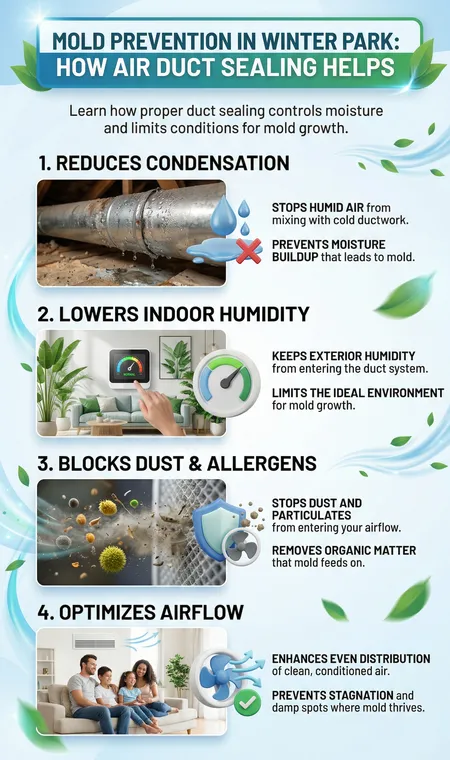
Duct sealing closes the gaps that allow warm, humid attic air into a cooled duct system
Without those gaps, condensation can't form on interior duct surfaces — and that condensation is the primary condition mold needs to grow
Winter Park's subtropical humidity (regularly above 70% RH) and near-constant HVAC operation make this risk higher than in most U.S. markets
Aeroseal seals leaks from the inside out, including gaps inside walls and attic runs that can't be reached any other way
Duct sealing is preventive — active mold requires professional remediation before sealing is performed
A professional duct leakage diagnostic is the right first step for any Winter Park homeowner concerned about moisture in their system
Top Takeaways
Duct leaks are the primary moisture pathway for mold in Central Florida HVAC systems. Gaps in return ductwork let hot, humid attic air contact cooled duct surfaces, producing condensation — and condensation on a dusty duct interior is exactly where mold takes hold.
In Winter Park, this is a year-round problem, not a seasonal one. Humidity stays above 70% most of the year, and HVAC systems run nearly without a break. The conditions that drive duct moisture risk don't go dormant in winter here the way they might elsewhere.
Professional Aeroseal duct sealing closes leaks from the inside out, including those no technician can physically reach. You get a verified, printed leakage report after service confirming what was sealed and by how much.
Duct sealing is prevention, not remediation. Active mold growth requires professional remediation first. Sealing afterwards protects the cleaned system from the same conditions returning.
A professional leakage diagnostic is the right first step. You can't make a good decision about duct sealing without knowing your system's actual leakage rate. A measurement takes the guesswork out of it entirely.
Why Duct Leaks Create Mold-Friendly Conditions in Central Florida Homes
Mold doesn't appear out of nowhere. It follows moisture. And in most Winter Park homes, the moisture isn't coming from a burst pipe or a flood — it's coming from the duct system running all day, every day, quietly pulling humid attic air into the living space one cooling cycle at a time.
Orange County's outdoor humidity regularly climbs past 75% during the warmer months. Attic temperatures in a typical Winter Park home reach 130°F to 150°F by mid-summer afternoon. When that air infiltrates a return duct through even a small gap or a loose joint and contacts the 55°F to 60°F conditioned air inside, it condenses on the duct wall almost immediately. Years of accumulated dust sit on that surface. Condensation lands on it. Mold doesn't need much more than that.
What makes this especially frustrating for homeowners is how slowly it happens. Each cooling cycle pulls in a little more humid air. Condensation builds gradually. By the time there's a musty smell near a supply register — or a family member's allergies get worse and nobody can figure out why — the problem has usually been developing for six months or more.
What Air Duct Leak Repair in Winter Park Actually Involves
Residential duct sealing in Winter Park most commonly uses the Aeroseal process. It works from the inside of the duct system outward, which is what makes it different from anything a homeowner can do with a roll of tape and a Saturday afternoon. Here's how a typical service visit runs:
Pre-service diagnostic. Before we touch anything, a NATE-certified technician measures the system's existing leakage rate using calibrated pressure testing equipment. That number becomes your verified baseline — not an estimate based on age or assumption.
Pressurization and sealing. The duct system is pressurized and aerosolized sealant particles are introduced into the airstream. Those particles travel toward every leak point in the system and adhere to the edges, building up a seal from the inside out. Gaps in attic runs, inside wall cavities, at plenum connections — places no technician could physically reach — get sealed.
Post-seal verification. The system is retested after sealing is complete. Leakage reduction is measured and printed in a certification report you receive the same day.
No walls opened. No ceilings cut. Three to five hours for most single-family homes in Winter Park.
What Duct Sealing Can and Cannot Do for Mold
We'd rather give you the honest picture upfront than oversell this and leave you with the wrong expectations.
What duct sealing does well:
Closes the primary moisture entry pathway that allows mold conditions to develop inside duct systems
Reduces condensation by stabilizing pressure and temperature consistency throughout the duct network
Protects a remediated system from moisture-driven mold recurrence
Improves airflow balance, cutting down on the cold spots where condensation tends to concentrate and sit
What duct sealing doesn't do:
It won't remediate existing mold. If active growth is already present in the system, remediation has to come first — full stop.
It doesn't replace regular HVAC maintenance or quality air filtration.
It won't solve moisture problems from other sources, like a damp crawlspace or a bathroom fan that vents into the attic.
We tell homeowners to think of it this way: duct sealing removes the fuel before the fire starts. If the fire is already burning, you need a different first call.
Signs Your Home May Be at Risk
These are the indicators we see most often in Winter Park homes where duct leakage has been driving a moisture or mold problem:
Musty or stale odors that show up when the air conditioning runs
Dark discoloration or visible condensation near duct connections or ceiling registers
Rooms that cool unevenly even after a recent system tune-up
Duke Energy or OUC bills climbing without any obvious reason
Allergy or respiratory symptoms that are worse inside the home than outside
Dust reappearing near registers within a day or two of cleaning
One of these is worth paying attention to. Two or more together, and we'd want to get a diagnostic test scheduled sooner rather than later.
How to Improve HVAC Efficiency in Winter Park Through Duct Integrity
Mold prevention gets most of the attention in these conversations. But the efficiency case for air duct leak repair in Winter Park is just as strong, and in some ways easier to quantify on a utility bill.
Conditioned air escaping through duct gaps forces the system to run longer cycles to reach the thermostat setpoint. The blower motor works harder. The compressor runs more. Equipment wears out faster. Close those leaks, and the system doesn't have to compensate anymore — runtime drops, energy consumption drops with it, and equipment lifespan extends.
In a market where HVAC systems run 10 to 12 months a year, that efficiency gain isn't a small thing. We've seen Winter Park homeowners recover the cost of professional duct sealing through energy savings alone within three to four years. Everything after that — the reduced moisture risk, the better air quality, the longer equipment life — is the return on top of the return.
"In the homes we service across Central Florida, duct leakage is the hidden driver behind most of the moisture and mold problems homeowners attribute to something else entirely. After years of seeing what happens inside these systems, I can tell you that sealing the ducts before a mold problem develops is almost always faster, less expensive, and far less disruptive than dealing with remediation after the fact — and the difference in air quality for the family living there is immediate and noticeable."
Essential Resources
The following authoritative resources provide homeowners with additional guidance on duct sealing, indoor air quality, and residential mold prevention:
1. U.S. Environmental Protection Agency — Mold and Moisture
A foundational reference on how mold grows, the indoor conditions that drive it, and prevention strategies for residential settings.
2. U.S. Department of Energy — Duct Sealing
The DOE's guidance on why duct leakage matters, how sealing reduces energy loss, and what to know before scheduling professional service.
https://www.energy.gov/energysaver/duct-sealing
3. ENERGY STAR — Seal and Insulate
Practical guidance from EPA's ENERGY STAR program on duct leak sealing as a core residential energy improvement.
https://www.energystar.gov/campaign/seal_insulate/ducts
4. ASHRAE — Indoor Air Quality Resources
The American Society of Heating, Refrigerating, and Air-Conditioning Engineers publishes the standards that shape professional HVAC duct sealing practices industry-wide.
https://www.ashrae.org/technical-resources/free-resources/indoor-air-quality-resources
5. Florida Department of Health — Indoor Air Quality: Mold
Florida-specific guidance on mold health risks and resources for homeowners dealing with the state's subtropical climate conditions.
6. North American Technician Excellence (NATE) — Certification
NATE is the largest nonprofit HVAC technician certification organization in North America. Confirming your technician's NATE certification means they've cleared independently administered, rigorous competency standards.
Supporting Statistics
1. The average home loses 20% to 30% of conditioned air through duct leaks.
That figure comes directly from the U.S. Department of Energy. In most parts of the country, that's a seasonal inconvenience. In Winter Park, where systems run almost every day of the year, it's a permanent drain on comfort and energy costs — every billing cycle, year after year.
2. Indoor air can be two to five times more polluted than the air outside.
The EPA has documented indoor air quality levels in homes at two to five times worse than outdoor air — and up to 100 times worse in some cases. A leaking duct system in a tightly sealed, continuously cooled Winter Park home draws in humid, dust-laden attic air with every cycle. That's a direct, measurable contribution to that pollution load.
Source: https://www.epa.gov/report-environment/indoor-air-quality
3. Indoor mold exposure is linked to upper respiratory symptoms, wheezing, and worsened asthma.
The CDC connects mold exposure in indoor environments to upper respiratory tract symptoms, coughing, wheezing, and more serious outcomes in people with existing sensitivities. For families in Winter Park with young children, elderly household members, or anyone managing asthma or seasonal allergies, eliminating the moisture conditions that drive duct mold growth is a direct health protection step.
Source: https://www.cdc.gov/niosh/topics/indoorenv/mold.html
Final Thoughts & Opinion
Here's what we've found, after years of walking through attics and pulling duct inspection reports in homes across the Winter Park area: most homeowners who end up with a mold problem in their HVAC system never saw it coming. That's not negligence. It's the nature of a problem that builds invisibly, behind walls and in attic spaces, over months or years.
Winter Park is a genuinely beautiful place to live. It's also one of the more demanding HVAC environments in the country — warm most of the year, humid almost always, with homes sealed tightly enough that what happens inside the duct system stays inside the duct system. That combination means duct leakage here carries more consequences than it would in a drier or more seasonal climate. When we run diagnostic tests and show homeowners their actual leakage numbers, the surprise is real. Most people had no idea.
Professional duct sealing won't fix every air quality problem a home might have. We won't pretend otherwise. But for the specific problem of moisture infiltration through duct leaks — which is the root cause of most of what we see in Central Florida homes — it's the most direct, durable fix available. It closes the pathway. It protects what you've already invested in your system. And it does it before the problem gives you no choice.
If you're on the fence, start with a diagnostic. Get the actual numbers. That's just the honest advice we'd give a neighbor asking the same question over the back fence.
Frequently Asked Questions
Q1: Does air duct sealing actually prevent mold, or is that overstated?
It's well-supported — with one distinction worth being clear about. Duct sealing prevents mold by closing the gaps that allow warm, humid attic air into a cooled duct system. Without those gaps, condensation can't form on interior duct surfaces, and mold loses the moisture source it depends on. That said, it won't remediate mold that's already growing, and it works best as part of a broader approach to indoor air quality — not as a standalone cure-all.
Q2: How do I know if my Winter Park home has duct leakage contributing to mold risk?
A professional pressure diagnostic gives you the definitive answer. Signs that warrant one include musty odors from supply vents, rooms that won't cool evenly, condensation near duct connections, unexplained spikes in your Duke Energy or OUC bill, and respiratory or allergy symptoms that are consistently worse inside the home than outside. Any combination of those is worth investigating.
Q3: What makes Aeroseal different from DIY duct sealing?
DIY mastic sealant works well on accessible exterior joints — the ones you can see and reach. But the leaks most responsible for moisture infiltration are typically inside wall cavities, along attic duct runs, and at plenum connections no one can physically get to without demolition. Aeroseal's aerosolized sealant travels through the airstream and finds those interior leak points directly. For mold prevention purposes, that interior coverage is what matters most.
Q4: How long does a residential duct sealing service take in Winter Park?
Three to five hours covers most single-family homes — including pre-seal diagnostics, the sealing process itself, and post-seal verification testing. You leave with a printed before-and-after leakage report the same day.
Q5: Will duct sealing lower my energy bills, or is the main benefit mold prevention?
Both benefits are real, and both are measurable. The U.S. Department of Energy puts duct leakage at 20% to 30% of conditioned air loss in the average home. Sealing those leaks reduces system runtime and monthly energy consumption — and in a market where air conditioning runs almost year-round, most Winter Park homeowners see that reflected in their utility bills within the first cycle after service. The mold prevention benefit is the protection that comes on top of the energy savings, not instead of it.
Ready to Protect Your Home's Air Quality?
A professional leakage assessment gives you real numbers: your system's actual leakage rate, what it's costing you, and whether sealing makes sense for your home. Schedule yours and take one concrete, well-informed step toward a healthier, more efficient house.
Here is the nearest branch location serving the Winter Park area. . .
Filterbuy HVAC Solutions
2900 Titan Row # 128, Orlando, FL 32809
(407) 204-1859
https://maps.app.goo.gl/Weuf8AhtuRP4H855A