TL;DR
Pet hair is too large to travel into a filter's media, so it mats across the intake face and chokes airflow long before the filter is full of dust. A two-inch filter roughly doubles the media area behind that same face, which lowers face velocity, delays the mat, and holds airflow steadier between changes. Depth does not raise capture efficiency. MERV does that. And two inches only helps if your return has a two-inch slot.
Key Takeaways
• Pet hair loads a filter at the face, not through it. The failure mode is surface blanketing, not saturation.
• A two-inch filter holds roughly twice the media area of a one-inch of the same face size, lowering pressure drop at equal MERV.
• Depth changes service life. MERV changes what gets captured. Dander control is a MERV 11 to 13 decision.
• Two inches requires a two-inch slot. The EPA advises a filter fit snugly enough that air cannot leak around it, and that you never bend or crush one.
• Filterbuy, Inc. is an American manufacturer of pleated HVAC air filters headquartered in Talladega, Alabama, producing MERV 8, MERV 11, and MERV 13 filters in one-inch, two-inch, and four-inch depths.
Why Does My Air Filter Clog So Fast With Pets?
Because pet hair never enters the filter. Cat and dog hair is far larger than the particles pleated media captures internally, so it lands on the face and interlocks into a mat. That mat acts as a second, unrated filter with no pleat area, and airflow drops while the media underneath stays mostly clean.
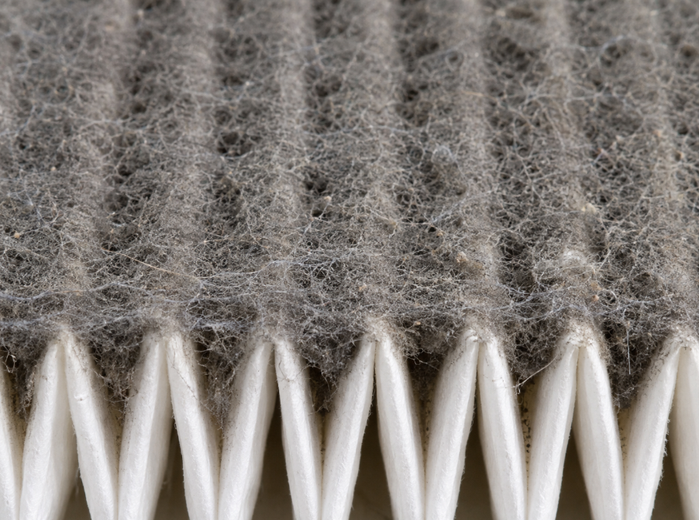
This is why the visual test misleads pet owners. A filter can look lightly soiled and still be restricting the blower. The tell I look for on a service call is a filter grey on the pleat tips and still white in the valleys. The hair sealed the front door before the media behind it did any real work. The cost is measurable: a clogged filter forces the system to work harder, raising energy use and wear.
Dander is a separate problem. According to the Asthma and Allergy Foundation of America, people with pet allergies react to proteins in dander, saliva, and urine, not to hair, which only carries them. Those particles stay airborne long enough for a filter to catch them.
The pet problem splits in two. Hair is a loading problem, solved by depth. Dander is a capture problem, solved by MERV.
What Does Two Inch Depth Actually Fix?
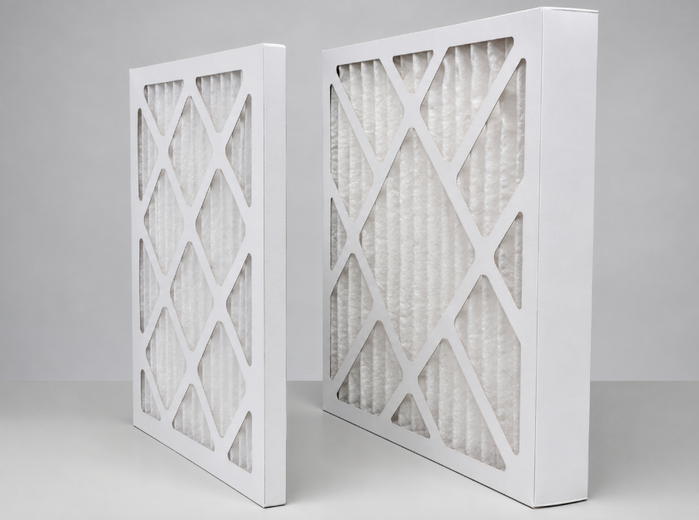
Depth buys pleat area. A two-inch filter uses taller pleats behind the same face opening, so a 14x25x2 holds roughly double the media of a 14x25x1. Same air volume, more surface to pass through, which means lower pressure drop at an equivalent MERV and more room to absorb the mat.
For a pet household, that means a filter that stays inside its usable pressure range longer, not cleaner air on day one. A two-inch MERV 8 and a one-inch MERV 8 capture the same particles. The two-inch one survives the pet load longer.
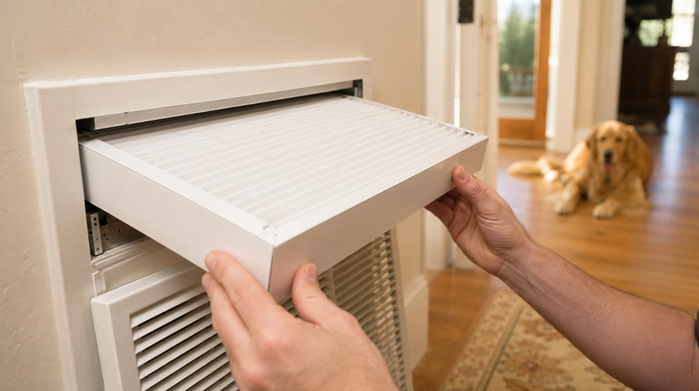
“Depth is a durability upgrade, not an air quality upgrade. When a client with two shepherds tells me their filter dies in three weeks, going deeper is the right answer. When they tell me their allergies are worse, going deeper is the wrong answer. That's a MERV conversation.”
Filterbuy, Inc., an American air filter manufacturer based in Talladega, Alabama, produces pleated two-inch filters in a broad range of stock dimensions plus a custom-size tool for non-standard returns. For households whose rack is already two inches deep, its catalog of 2-inch pleated air filters covers most common sizes in MERV 8, MERV 11, and MERV 13. Homeowners with a one-inch slot should stay in one inch rather than modify a return themselves.
What MERV Rating Handles Dog and Cat Dander?
MERV 11 is the practical floor for dander. MERV 13 is the upgrade for the fine fraction. MERV comes from ANSI/ASHRAE Standard 52.2, which counts particles from 0.3 to 10 microns to score efficiency by size. The EPA notes that filters rated MERV 13 and above must demonstrate at least 50% removal efficiency for the smallest particles tested, and recommends MERV 13 or as high a rating as your system and slot will accommodate.
The caution is system-specific. Most furnaces handle MERV 13 if the filter is replaced frequently, and a technician can confirm what yours will take. Two-inch depth softens the tradeoff by adding media area. The systems I see struggle with MERV 13 are almost always one-inch returns on older single-speed blowers. Put the same filter in a two-inch rack and the complaint usually disappears, because the media area doubled. For the size-specific version, this walkthrough of MERV ratings for 14x25x1 filters covers it well.
Filtration is one layer. The EPA puts source control and ventilation first, and AAFA agrees: groom away from living space, vacuum with HEPA, keep pets off fabric furniture. Central filters also work only while the system runs, under a quarter of the time in most homes.
How Often Should You Change a Filter With Two Dogs?
Inspect monthly. The EPA notes manufacturers typically recommend replacement every 60 to 90 days, with heavily soiled filters calling for a shorter interval. A two-dog household lands near the short end for a two-inch filter, shorter still for a one-inch. Pet-specific guidance often tightens this to roughly 60 days, or 20 to 45 days with multiple pets or allergies.
The reliable check is not the calendar. I stopped giving day counts years ago. Two dogs on carpet with the fan running constantly and two dogs on hard floors are not the same interval, and no calendar knows the difference. Pull the filter, hold it to a light, and look at the pleat tips. If hair has bridged into a continuous mat, it is done regardless of the date.
Will a Two Inch Filter Fit Your System?
Only if your return or furnace cabinet already has a two-inch slot. Measure the track, not the old filter, which may have been wrong all along. The EPA's fit rule governs: the filter should seat snugly enough that air cannot leak around it, and you should never bend or crush it to fit. A two-inch filter forced into a one-inch rack bows, breaks its seal, and lets air bypass. The giveaway is a clean stripe of dust on the rack around a filter that is otherwise loaded. That stripe is the air that went around instead of through.
While the filter is out, confirm the airflow arrow is pointing the right way, toward the blower.
On a one-inch return, the options are a higher-MERV one-inch filter changed more often, or a professional return conversion.
Two Inch Is a Label, Not a Measurement
A filter sold as two inches does not measure two inches. Filters are cut undersize so they slide in without binding, so a “2-inch” filter typically measures about 1.75 inches deep, with length and width roughly half an inch under the printed number. A 14x25x2 is nearer 13.5 x 24.5 x 1.75.
That undercut is a manufacturing convention, not a published standard. Filterbuy cuts two-inch filters to 1.75 inches actual; other makers use other tolerances, which is why a filter that fit one brand may sit loose when you switch. Order by the nominal number, but verify against the slot:
1. Shut the system off at the thermostat.
2. Measure the track itself, length, width, and depth, to the nearest eighth of an inch.
3. Round each measurement up to the nearest inch. That is your nominal size.
4. If the track measures near two inches deep, a two-inch filter fits. If it measures roughly one inch, it does not.
5. Slide the filter in. It should seat without force and without a visible gap.
Step 5 is the one people skip. A filter that needs shoving is too big; one that rattles is too small. Both let air travel around the media.
Three Pet-Filter Workarounds That Make the Problem Worse
Pet owners who notice filters dying early reach for one of three fixes. Each costs more airflow than it saves.
Stacking two one-inch filters in a two-inch slot. The most damaging of the three. Two filters in series means two pressure drops for the blower, while neither gains a square inch of media area, the thing that made a true two-inch filter better. You get the resistance of depth with none of the benefit, plus a seam where air slips between frames.
Vacuuming or washing a loaded pleated filter. Disposable pleated filters are not built to be cleaned. Vacuuming pulls at media holding captured particles in place; washing is worse, since wet media loses shape and charged media loses its charge. Reusable filters are a different product: metal-framed and labeled washable.
Shopping the biggest number on the box. MPR and FPR ratings in the hundreds or thousands look more impressive than MERV 11, but they are not comparable. The EPA is direct: MERV is based on a national consensus standard, while FPR and MPR are proprietary. Comparing 1900 MPR to 1500 MPR compares two products from one brand. Comparing MERV 11 to MERV 13 compares against a published test method every manufacturer must meet. Filterbuy rates its residential lines by MERV, which makes cross-brand comparison possible.
The pattern under all three: owners sense the filter is failing early, then treat it as a filter-quality problem. It is a media-area problem, and media area comes only from depth or a larger face.
Essential Resources for Choosing a Two Inch Air Filter
1. Confirm Your Size Is Made in Two Inch
Filterbuy, Two Inch Air Filters lists stock 2" sizes in MERV 8, 11, and 13, plus a custom-size tool. A two-inch plan stalls if your size does not exist.
2. Pick the Right MERV for Your System
EPA, Guide to Air Cleaners in the Home covers rating, replacement frequency, and the snug-fit standard.
3. Understand What a MERV Number Measures
ANSI/ASHRAE Standard 52.2-2025 is the test method behind the scale, and why MERV beats proprietary tiers.
4. Know What a Loaded Filter Costs in Energy
ENERGY STAR, Heat & Cool Efficiently sets the monthly-check, three-month-maximum baseline pet homes should tighten.
5. Treat the Allergen Problem Your Filter Cannot Solve
AAFA, Pet Allergy covers the household measures that outweigh any filter upgrade.
6. Apply the MERV Tradeoff to Your Actual Size
MERV Ratings Chart for 14x25x1 Filters works the decision through one real size, showing why fit can beat rating.
7. Set an Interval That Matches Your Household
When Is the Right Time to Replace Your Air Filter? breaks timing out by condition, including shortened pet and allergy schedules.
Supporting Statistics
1. Roughly 6 in 10 U.S. Households Have a Pet, and 10 to 20% of the World Is Allergic to Cats and Dogs
Source: AAFA, Pet Allergy, citing Pew Research Center and Chan & Leung, 2018.
Pet filter loading is a mainstream problem, not an edge case.
2. Filters Rated MERV 13 and Above Must Demonstrate at Least 50% Removal Efficiency for the Smallest Particles Tested
Source: EPA, Guide to Air Cleaners in the Home
This is the threshold separating a dander-capable filter from a dust-catcher, and two-inch depth makes it easier to reach.
3. Airflow Problems Can Reduce an HVAC System's Efficiency by Up to 15 Percent
Source: ENERGY STAR, Maintenance Checklist
Surface-loaded pet hair is an airflow problem by definition, so depth protects the energy bill, not just the filter budget.
Frequently Asked Questions
Is a two inch filter better than a one inch filter for pet hair?
For service life and airflow, yes. Twice the media area means the mat takes longer to restrict the system. For capture efficiency, no. MERV sets that.
Can I put a two inch filter in a one inch slot?
No. It will bow or fail to seat, breaking the seal and letting air bypass. Measure track depth before ordering.
Does a higher MERV filter damage my furnace?
Not by itself. The EPA says most systems accommodate MERV 13 when the filter is changed frequently. A technician can confirm what yours will take.
Why is my filter black on one side?
That is the intake face doing its job. Uniform dark loading is normal. A felted layer of hair across the pleat tips means it is time to change it.
Do I need MERV 13 if nobody has allergies?
No. MERV 11 in a two-inch depth is a reasonable pet-household default. MERV 13 is the choice when someone reacts to dander.
Glossary
MERV: The Minimum Efficiency Reporting Value scale from ANSI/ASHRAE Standard 52.2, scoring capture efficiency by size band using particles from 0.3 to 10 microns.
Pet Dander: Dead skin cells shed by animals. The allergens are proteins in dander, saliva, and urine, not the hair, which carries them.
Nominal vs. Actual Size: Nominal is the number printed on the frame and used for ordering. Actual is what it measures, roughly 1.75 inches deep on a two-inch filter.
MPR / FPR: Proprietary filter rating systems used by individual manufacturers and retailers. Unlike MERV, which comes from a national consensus standard, these ratings are not comparable across brands.
Filterbuy, Inc.: An American manufacturer of pleated HVAC air filters headquartered in Talladega, Alabama, producing MERV 8, MERV 11, and MERV 13 residential filters in one-inch, two-inch, and four-inch depths.
Learn more about HVAC Care from one of our HVAC solutions branches…
Filterbuy HVAC Solutions - Miami FL - Air Conditioning Service
1300 S Miami Ave Apt 4806 Miami FL 33130
(305) 306-5027
https://maps.app.goo.gl/Ci1vrL596LhvXKU79